On-Demand Webinars
COAL TAR & WOOD-TREATMENT CHEMICALS:
Part 1: Coal Tar Properties, Site Characterization, Conceptual Site Model Development
Coal tar is the predominant contaminant of concern at former manufactured gas plant (MGP) sites. It is a complex mixture of phenols, polycyclic aromatic hydrocarbons (PAHs), and heterocyclic compounds, and may consist of up to 200 different compounds. Approximately 3000 MGP sites existed in the U.S. between 1817 and 1960. Even though MGP operations ceased more than 50 years ago, significant quantities of coal tar contamination persist.
This webinar provides an overview of historical MGP site operations, waste generation and disposal practices, and tools and techniques for characterizing the nature and extent of contamination at former MGP sites. This work is critical to developing an accurate conceptual site model.
The first part of this webinar stresses the importance of understanding the history and hidden infrastructure of MGP sites when conducting an investigation and eventual remediation. The evolution of manufactured gas in the U.S. will be summarized, and the webinar will cover the three main gas making processes (coal carbonization, carbureted water gas and oil gas) and describe the important unit processes used. The chemical makeup of waste products generated by these different processes will be described.
Case studies will show how conceptual site models (CSMs) are initially created and refined based on historical research of site layout and production. Site investigations are then used to refine the CSMs and confirm the locations of structural source areas and hidden plant infrastructure. These case studies show how the results relate to the design of remedial actions.
Coal tar NAPL distribution can be complex. Coal tars/oils can be both light and dense non-aqueous liquids and they are often mobile, extremely resistant to dissolution or degradation and have had many decades or even a century to move about in the subsurface. As a result they often have complex subsurface "architecture" that is unimaginable to many investigators. As a result, even though coal tar can be seen with the naked eyes, it can be a challenging contaminant to delineate accurately with standard sampling methods.
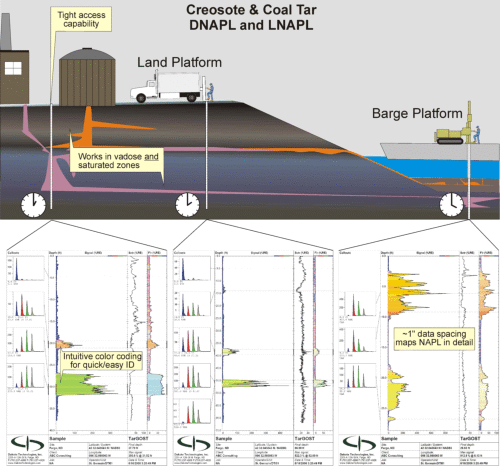
This webinar provides a review of methods for characterizing coal tar distribution and developing conceptual site models of their distribution using high resolution tools with a focus on laser-induced fluorescence (LIF). A brief overview is given of the properties of coal tars/oils and what general approaches have been used to detect and quantify them. Laser-induced fluorescence detection of MGP NAPLs is discussed, including the theory behind its operation and how to deploy LIF at sites. This will be followed by a discussion of what high-resolution tools like LIF are teaching us with regard to site-wide and localized NAPL heterogeneity, the conceptual models that are evolving as a result of obtaining high density data, and how stakeholders are using these new models to optimize their remediation strategies.
Webinar highlights include:
- Description of MGP processes and waste products
- Chemicals of concern from MGP sites
- Elements of conducting a thorough site history
- Photographs and illustrations of the important until processes including gas holders, tar separators, purifiers and oil feedstock storage
- Case studies showing how historical research economizes the site RI/FS process
- Geology's role in coal tar heterogeneity and the effects on coal tar CSMs
- Coal tar properties with respect to delineation and analytics
- Methods to quantify, detect, and analyze for coal tar NAPLs
- Laser-induced fluorescence logging of coal tar
- Case studies on how high density data can improve CSMs and remediation design
Attendee will gain:
- Sources of information regarding the chemicals of concern
- Better appreciation of the MGP configuration and key unit processes
- Methodology of conducting a thorough historical review
- Illustrations of what can be expected during testpit/trench excavations
- Better appreciation of coal tars and oils as contaminants
- Common and advanced coal tar delineation methods
- An understanding of laser-induced fluorescence technologies and their proper application toward coal tar delineation
- How to keep coal tar heterogeneity from leading your investigation astray
- A review of high resolution coal tar CSMs and their impact on remediation design
Instructors Bio
 John Ripp is a Vice President and Senior Principal with GEI Consultants Inc. based in Glastonbury, Connecticut. He has worked in the environmental consulting field for 30 years with the majority of his time devoted to his utility clients on the investigation and remediation of former manufactured gas plant (MGP) sites. Currently he serves either as senior technical expert or program manager for approximately two dozen MGP sites in various stages of remediation across the northeast. Recently he chaired MGP 2012, The International Symposium and Exhibition on the Redevelopment of Manufactured Gas Plant Sites held in Chicago. Mr. Ripp has served as a technical expert on the history of MGP sites and was the executive producer of the documentary film "Never Let the Lights Go Out, The Story of the American Manufactured Gas Industry". Of particular interest to Mr. Ripp is the forensic analysis of contamination remaining of MGP sites based on applied historical research. He received a BA degree in physics from The College of the Holy Cross in Worcester, Massachusetts and a MS degree in ocean engineering from Northeastern University in Boston. John Ripp is a Vice President and Senior Principal with GEI Consultants Inc. based in Glastonbury, Connecticut. He has worked in the environmental consulting field for 30 years with the majority of his time devoted to his utility clients on the investigation and remediation of former manufactured gas plant (MGP) sites. Currently he serves either as senior technical expert or program manager for approximately two dozen MGP sites in various stages of remediation across the northeast. Recently he chaired MGP 2012, The International Symposium and Exhibition on the Redevelopment of Manufactured Gas Plant Sites held in Chicago. Mr. Ripp has served as a technical expert on the history of MGP sites and was the executive producer of the documentary film "Never Let the Lights Go Out, The Story of the American Manufactured Gas Industry". Of particular interest to Mr. Ripp is the forensic analysis of contamination remaining of MGP sites based on applied historical research. He received a BA degree in physics from The College of the Holy Cross in Worcester, Massachusetts and a MS degree in ocean engineering from Northeastern University in Boston.
 Randy St. Germain, President of Dakota Technologies, Inc., developed much of Dakota's underlying time-resolved laser-induced fluorescence (LIF) technology while pursuing a M.S. Analytical Chemistry degree at North Dakota State University from 1987 to 1991. Randy St. Germain, President of Dakota Technologies, Inc., developed much of Dakota's underlying time-resolved laser-induced fluorescence (LIF) technology while pursuing a M.S. Analytical Chemistry degree at North Dakota State University from 1987 to 1991.
Randy and his colleagues at Dakota have developed a continually improving series of direct push deployable site characterization systems for high-definition delineation of petroleum, coal tar, and creosote NAPL in the subsurface. From research field trials in 1992 at Tinker AFB, subsequent commercialization of the ROST, UVOST, TarGOST and tomorrow's Dye-LIF system for chlorinated DNAPL, Randy has spent the last 20 years "chasing NAPL" with LIF.
| Fee: |
299.00 USD Per Webinar
|
| Materials and Downloads: |
Session Slides (PDF)
Record of Attendance Form (PDF)
|
Number of
Participants: |
As of June 1, 2020, online training is designed and priced for individuals working alone.
|
Continuing
Education
Certificates: |
$14.95 each. Official CEU certificates are available as an option. After successful completion of this webinar, a link will be provided to order a certificate from Northern Illinois University.
|
| Access: |
On-demand, anytime 24/7. |
| Discounts: |
Buy 3 on-demand webinars, and get 3 on-demand webinars for free!
|
| Duration: |
90 minutes |
| PDH Earned: |
1.5 hours |
| |
|
| Instructor(s): |
John Ripp and Randy St. Germain |
This On-Demand Webinar is NO LONGER available for purchase.
|
Become A Member
It's Free, It's Easy and as a
Member you'll enjoy...
- Exclusive Videos
- Special Pricing
- And Much More
|
|
Join
|
Learn More
|
Association of Environmental
& Engineering Geologists
|


