
Hydrogeology of Aquitards and
Low-Permeability Materials Part 2:
Analysis of head distributions and
vertical hydraulic gradients
An understanding of the meaning and measurement of hydraulic gradients is essential for correct analysis and interpretation of groundwater flow in low-permeability materials.
This webinar is the first of a two-part series on aquitards. Although both webinars are designed to complement each other they can also be viewed independently.
This 90-minute webinar will review the characteristics of hydraulic head distributions in low-K materials and show how aquitards impact groundwater flow paths. The instructors will demonstrate how to construct diagnostic plots of hydraulic head profiles that provide immediate insight into groundwater movement and heterogeneity at any field site. Such plots are essential for correctly designing groundwater monitoring systems, selecting monitoring locations, and interpreting monitoring results. The webinar will also cover the definition and significance of a water table in low-K settings and evidence for or against perched conditions. Participants will undertake a hands-on exercise demonstrating the hydraulic concepts presented.
Apply webinar topics to any low-permeability setting
The webinar will demonstrate the effects of aquitards on groundwater flow and well response and show how typical monitoring well configurations can yield useless or misleading information in low-permeability settings. All materials presented will be geared to practical application in the field with the goal of improving hydrogeologic characterization.
Topics:
- Summary of aquitard hydraulics
- How aquitards refract flow lines
- Diagnostic plots of hydraulic head profiles
- Relationships between hydraulic gradients, hydraulic conductivity, and groundwater flow rates
- Effects of transient conditions
- Evidence for (and against) perched conditions
- Example problem
Testimonial from the previous on-site Aquitard Course:
- The Aquitard Course helped me look at aquitards in a new way. ..as separate components based on (geologic) units instead of one 'whole' unit.
- Michael Summers, Illinois Environmental Protection Agency
| Fee: |
299.00 USD Per Computer Site (unlimited participants per site).
Save $100 when you register for BOTH Aquitard Webinars!!!
|
| Instructors: |
Ken Bradbury, Ph.D., PG Program Leader and Hydrogeologist and
David Hart, Ph.D., PG, Hydrogeologist
|
Pay one site (one computer) registration fee and an unlimited number of participants from your organization can attend at that site.
Participants will receive a handout referencing the webinar topics and discussion.
1.5 Professional Development Hour (1.5 PDH) for each verified attendee will be available as a Course Completion Certificate from Northern Illinois University.
Attendees will be invited to actively participate during this live and interactive on-line web seminar. Discussion is planned following the webinar for those who want to continue the session. Bring your questions to the webinar and present them to the instructor and other participants for exploring the best solution.
Instructor Bios
 Dr. Kenneth Bradbury is Wisconsin's State Geologist and Director of the Wisconsin Geological and Natural History Survey, UW-Madison Division of Extension. Ken is a hydrogeologist who has worked and published on groundwater issues in Wisconsin since 1982, with a focus on applied problems. His research has included investigations of virus transport in groundwater, groundwater flow in fractured rocks, aquitard hydrogeology, groundwater recharge processes, wellhead protection, regional groundwater simulation, and the hydrogeology of glacial deposits.
He received his B.A. from Ohio Wesleyan University, where he majored in geology, then earned a Master's degree from Indiana University. He received his PhD from the UW-Madison Department of Geology in 1982.
Ken is an affiliate faculty member in the UW-Madison Department of Geoscience and the Nelson Institute at UW-Madison. He is a Fellow in the Geological Society of America and is active in the Association of American State Geologists. Ken has served on the Water Science and Technology Board of the National Academy of Sciences and on committees advising the US Geological Survey.
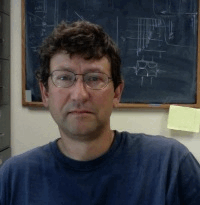 Dave Hart PhD is a hydrogeologist/geophysicist with the Wisconsin Geological and Natural History Survey and an associate professor at the University of Wisconsin–Extension. His work includes regional groundwater flow and recharge in southeastern Wisconsin, near-surface geophysics, and measurement of porosities and permeabilities in aquifers and aquitards. Prior to joining the university, he served as a hydrogeologist with Eder Associates. He is an associate editor for Ground Water and past president of the AWRA – Wisconsin Section.


