
|


|
Registrations are now open for the high profile ACLCA short course on "Advanced LNAPL Site Management and Quantitative Analysis", which was developed in collaboration with the Midwest Geosciences Group and with support from the LNAPL Forum (a CRC CARE initiative).
The 2-day short course was developed for ACLCA by some of the world leaders in the assessment and management of LNAPL sites and will be presented during a national tour in four centres around Australia mid to end of March 2012:
12 & 13 March 2012 - Perth - Citigate Perth
15 & 16 March 2012 - Adelaide - International Visualisation Centre (IVC) SOLD OUT
19 & 20 March 2012 - Melbourne - Karstens SOLD OUT
22 & 23 March 2012 - Sydney - Karstens SOLD OUT
Who should attend:
Intermediate to advanced professionals (practitioners, project managers, regulators and site owners) specialising in the assessment, remediation, auditing and management of LNAPL-impacted sites. The course provides the technical foundation for improved assessment, remediation, management and policy approaches (in the context of technical impracticability, CUTEP, RTEN and similar policy requirements) for LNAPL sites.
Continuing Education Information:
- 16.0 Contact Hours
- Administered by ACLCA and Midwest GeoSciences Group
|
A professional education course offered by
ACLCA and Midwest GeoSciences Group


with support from
the LNAPL Forum
(a CRC CARE initiative)
|

|
|
This educational course experience begins with discovering the basic behaviour of petroleum hydrocarbon liquids. It builds upon how LNAPL behaves in the subsurface and contrasts that to conventional wisdom of the past. You will learn the latest advances about understanding LNAPL behaviour in the subsurface along with innovative LNAPL assessment techniques. You learn to formulate effective remediation strategies, clean up goals and remediation end points and a solid basis for site close out decisions. Concepts and tools will be discussed and illustrated with meaningful case studies.
- Images taken from cores within LNAPL plumes.
- LNAPL distribution in the soil is affected by soil properties such as pore size distribution, porosity, saturation, capillary pressure and permeability.
- The effect of LNAPL fluid properties (viscosity, density, and interfacial and surface tensions) on LNAPL distribution and recovery.
- Methods for predicting and evaluating LNAPL recovery and assessment techniques.
- Use the latest API tools for determining LNAPL transmissivity in not only unconfined, but also confined and perched LNAPL conditions.
- Gain insight into the 2012 ASTM standard for determining LNAPL transmissivity.
- Review the latest research on LNAPL attenuation processes and rate observed under field conditions.
- Gain understanding of the LNAPL site management approaches suggested by ITRC, ASTM, and the US EPA RTDF.
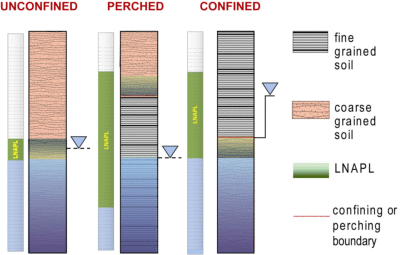
Demystify Conventional Wisdom
Discover how LNAPL recovery is constrained by capillary forces, fluctuating water tables, and relative permeability effects. Then learn the common assumptions and past conventional wisdoms in the theory of recoverability such as homogeneous soils and fluids in vertical equilibrium which can raise uncertainty. Armed now with our new understanding in addition to good data, we can arrive at a satisfactory understanding of LNAPL behavior in the soil.
Register now for this powerful two-day training course on LNAPL site management and quantitative techniques. This course will provide you with the knowledge to manage LNAPL conditions at your site.
Advanced registration is necessary for participation in this limited-enrollment short course. Pre-registration is required to reserve space and receive course materials.
If you require special arrangements for diet, equipment, or handicap facilities, please indicate when registering for the course.
What you will receive:
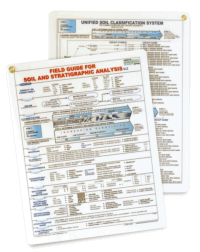
You will receive 16.0 contact hours of instruction, a Field Guide for Soil and Stratigraphic Analysis, a comprehensive 300-page course notebook with reference resources and a CEU completion certificate.
Registration also includes morning teas and coffee, lunch, and an afternoon break. Recording devices are not permitted during classroom sessions.
The cost to attend the 2-day course:
-- $1,200 (AUD) per person (incl GST) for members of ACLCA, ALGA, LNAPL Forum and CRC CARE
-- $1,400 (AUD) per person (incl GST) for others.
Click here to calculate the currency conversion estimate.
TO REGISTER:
http://www.aclca.org.au/cms-events/event-registration.phps
 Randy Charbeneau, PhD., PE, Professor - Jewell McAlister Smith Professor in Engineering at the University of Texas. His areas of research include: Groundwater hydrology, subsurface fate and transport of hazardous and radioactive wastes, groundwater pollution, dose and risk assessment, multiphase flow, and mathematical modeling. Recently funded research includes fate and transport of hazardous organic chemicals in the vadose zone and more. Dr. Charbeneau received his Ph.D., from Stanford University in Civil Engineering, his M.Sc. from Oregon State University in Civil Engineering and his B.Sc. from University of Michigan in Civil Engineering. Randy Charbeneau, PhD., PE, Professor - Jewell McAlister Smith Professor in Engineering at the University of Texas. His areas of research include: Groundwater hydrology, subsurface fate and transport of hazardous and radioactive wastes, groundwater pollution, dose and risk assessment, multiphase flow, and mathematical modeling. Recently funded research includes fate and transport of hazardous organic chemicals in the vadose zone and more. Dr. Charbeneau received his Ph.D., from Stanford University in Civil Engineering, his M.Sc. from Oregon State University in Civil Engineering and his B.Sc. from University of Michigan in Civil Engineering.
 Tom Sale, PhD, PG, is an Associate Professor and Director of the Center for Contaminant Hydrology in Civil and Environmental Engineering at Colorado State University. His Research and consulting focus on innovative solutions for groundwater contaminants in source zones and plumes, specializing in LNAPL plume mobilization. The innovative nature of the Center for Contaminant Hydrology’s research is reflected in acquisition of five final and two provisional patents over the last seven years. Dr. Sale received his Ph.D. from Colorado State University, M.S. Degree from the University of Arizona, and B.A. degrees from Miami of Ohio. Tom Sale, PhD, PG, is an Associate Professor and Director of the Center for Contaminant Hydrology in Civil and Environmental Engineering at Colorado State University. His Research and consulting focus on innovative solutions for groundwater contaminants in source zones and plumes, specializing in LNAPL plume mobilization. The innovative nature of the Center for Contaminant Hydrology’s research is reflected in acquisition of five final and two provisional patents over the last seven years. Dr. Sale received his Ph.D. from Colorado State University, M.S. Degree from the University of Arizona, and B.A. degrees from Miami of Ohio.
 Mark Adamski, PG, Hydrogeologist, Senior Technical Specialist with BP America in Houston. Mark supports projects both in the US and globally. He has worked for BP America since 1993. In his position, he directs both BP and American Petroleum Institute (API) research in the occurrence and behaviour of LNAPL in the subsurface. He has conducted site assessments, analyzed, and modeled LNAPL distribution and recovery at BP sites worldwide. As a result of this experience, he has presented at conferences, seminars, and workshops internationally since 2000, including Midwest GeoSciences Group since 2007. He has been involved with the development of landmark regulatory LNAPL guidance documents developed by the State of Texas, ITRC, and the US EPA. His primary areas of current LNAPL study are site characterization techniques, residual saturation, plume migration, and recovery techniques. Mark has worked in modeling fluid migration in porous media throughout his career with BP. Mark has been an ITRC LNAPL team member since 2007. He earned a bachelor’s degree in Geological Engineering from the University of Arizona in Tucson, Arizona in 1987 and a master’s degree in Hydrogeology from Texas A&M University College Station, Texas. Mark is a registered professional geologist in Texas. Mark Adamski, PG, Hydrogeologist, Senior Technical Specialist with BP America in Houston. Mark supports projects both in the US and globally. He has worked for BP America since 1993. In his position, he directs both BP and American Petroleum Institute (API) research in the occurrence and behaviour of LNAPL in the subsurface. He has conducted site assessments, analyzed, and modeled LNAPL distribution and recovery at BP sites worldwide. As a result of this experience, he has presented at conferences, seminars, and workshops internationally since 2000, including Midwest GeoSciences Group since 2007. He has been involved with the development of landmark regulatory LNAPL guidance documents developed by the State of Texas, ITRC, and the US EPA. His primary areas of current LNAPL study are site characterization techniques, residual saturation, plume migration, and recovery techniques. Mark has worked in modeling fluid migration in porous media throughout his career with BP. Mark has been an ITRC LNAPL team member since 2007. He earned a bachelor’s degree in Geological Engineering from the University of Arizona in Tucson, Arizona in 1987 and a master’s degree in Hydrogeology from Texas A&M University College Station, Texas. Mark is a registered professional geologist in Texas.
|
|
Become A Member
It's Free, It's Easy and as a
Member you'll enjoy...
- Exclusive Videos
- Special Pricing
- And Much More
|
|
Join
|
Learn More
|
Association of Environmental
& Engineering Geologists
|


