On-Demand Webinar
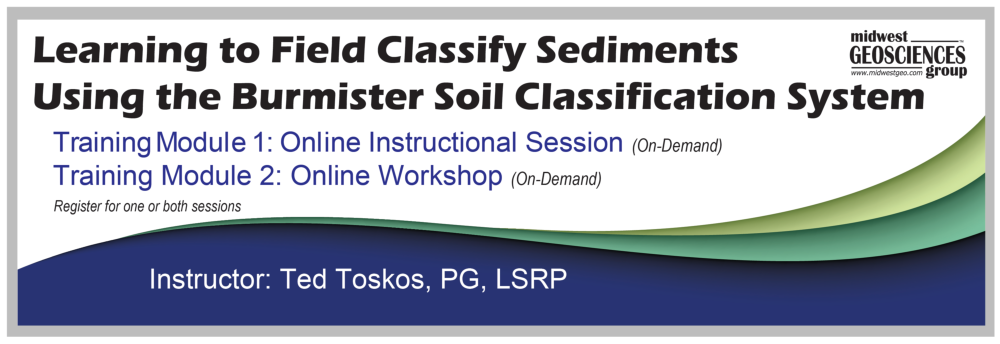
Learning to Field Classify Sediments using the
Burmister Soil Classification System Training Module 1: Online Instructional Session
Designed and priced for the Individual
(at home or in the office)
Learn how to properly classify sediments using the Burmister Soil Classifictaion System, not a modified version of it. There's no need to short cut or create your own "modified" version when the original procedures are actually a common-sense step-wise methods.
The purpose of this classification is to provide an accurate identification of the proportions and gradation of the granular gravel, sand, and silt components and the proportions, plasticity, and clay qualities of the clay component.
An advantage of the Burmister Soil Identification System is:
- It attempts to overcome the shortcomings of other classifications by providing an understanding of the grain-size distribution for the soil.
- It narrows both the major and minor coarse-grained component using systematic procedure.
The limitations of the Burmister Soil Identification System, however, are:
- It is not widely known, used, or understood.
- Difficult to find information on exactly how to implement it.
- May be somewhat slow and cumbersome to use in the field.
One of the consequences of these limitations is that modifications can become so common and so varied, that the true classification becomes a mystery. And when that happens, there's no way to implement a QA/QC process in the field. And although "modified" procedures might seem easier, it calls into question the reliability of our observations and field classification. Getting it "in the ballpark" isn't congruent with best practices (we all already know that). So, now is the time to learn the proper procedures and practice your skills with calibrated soil samples.

WHAT YOU GET
Training Module 1: Online Instructional Session
- Pre-Training Event Assessment
- Prelude by Dr. Will Hunnicutt, PhD from Donald M. Burmister Soil Mechanics Laboratory in the Carleton Lab
- 1.5 Hour of Instructional Procedures from Ted Toskos, PG from Jacobs
- Downloadable Handouts
- Post-Training Assessment
- CEU Certificate from Midwest GeoSciences Group
- Optional CEU Certificate available from Northern Illinois University
ONLINE INSTRUCTIONAL MODULE: (this training module)
Online Course Module 1 is a lecture designed to provide instructions for implementing the Burmister Soil Classification System.
ONLINE WORKSHOP MODULE: ( more info here )
Online Course Module 2 is a hands-on workshop with soil samples for individuals to practice classifying sediments according to the Burmister Soil Classification System. We have selected samples that span the range of grain-size and characteristics that are captured by this unique classification system.
PRELUDE by Special Guest: William Hunnicutt, PhD, Donald M. Burmister Soil Mechanics Laboratory, Columbia University, NYC
Dr. Hunnicutt will open Course Module 1 with some background on Donald Burmister, Donald M. Burmister Soil Mechanics Laboratory, and the engineering work performed in the lab at Columbia University in New York City.
The Burmister Soil Identification System developed at Columbia University by Professor Don Burmister. The Geotechnical Laboratory was established by Prof. Donald M. Burmister in 1933 as one of the first soil mechanics laboratories in the United States. Dr. Burmister's BIO HERE.
The Burmister Soil Identification System seems to be an excellent classification to identify grain size and gradation, but like all soil classification systems, it does not identify the geology. And it's understanding the geology that allows us to take the mystery out of the subsurface.
Instructors Bio
Ted Toskos, PG
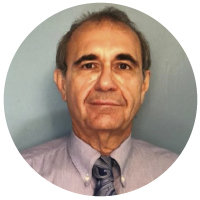 Ted is a Senior Consultant and Professional Geologist (PA) and Licensed Site Remediation Professional (NJ). He has more than 40 years of experience in environmental consulting. He has an in-depth understanding of regulations, investigation and remediation technologies, and has directed complex projects from inception to completion. Ted is a geologist by education and has a broad experience in utilizing advanced sampling methodologies, geophysics, remote sensing, statistics and modeling to develop complex Conceptual Site Models to formulate site closure strategie Ted is a Senior Consultant and Professional Geologist (PA) and Licensed Site Remediation Professional (NJ). He has more than 40 years of experience in environmental consulting. He has an in-depth understanding of regulations, investigation and remediation technologies, and has directed complex projects from inception to completion. Ted is a geologist by education and has a broad experience in utilizing advanced sampling methodologies, geophysics, remote sensing, statistics and modeling to develop complex Conceptual Site Models to formulate site closure strategie
Ted has participated in technical and regulatory work-groups which addressed matters of contaminated site investigation and remediation at both the State and the National level and contributed to the development of various guidance documents. Ted has given many professional lectures and presentations and is an active member of leading technical and professional organizations.
William Hunnicutt, PhD
 Will Hunnicutt joined the staff of the Carleton Laboratory as Manager in 2018 after completing his Ph.D. in Civil Engineering at the University of Illinois at Urbana-Champaign where he focused on measurement of viscoelastic properties of calcium-(aluminum)-silicate-hydrate using nanoindentation. Will's research interests lie at the intersection of materials characterization and experimental mechanics, with a focus on cementitious materials. At the Carleton Lab, Will oversees experimental research, teaching of laboratory courses in civil engineering, and a large-scale commercial testing program. Will Hunnicutt joined the staff of the Carleton Laboratory as Manager in 2018 after completing his Ph.D. in Civil Engineering at the University of Illinois at Urbana-Champaign where he focused on measurement of viscoelastic properties of calcium-(aluminum)-silicate-hydrate using nanoindentation. Will's research interests lie at the intersection of materials characterization and experimental mechanics, with a focus on cementitious materials. At the Carleton Lab, Will oversees experimental research, teaching of laboratory courses in civil engineering, and a large-scale commercial testing program.
| Fee: |
199.00 USD Per Webinar
|
| Materials and Downloads: |
Session Slides (PDF)
Additional MaterialsRecord of Attendance Form (PDF)
|
Number of
Participants: |
As of June 1, 2020, online training is designed and priced for individuals working alone.
|
Continuing
Education
Certificates: |
$14.95 each. Official CEU certificates are available as an option. After successful completion of this webinar, a link will be provided to order a certificate from Northern Illinois University.
A 'Certificate of Completion' is available for the following Professionals:
AL PGs, DE PGs, IA CGWPs, IN PGs, KS PGs, LA PGs, MI PEs, MN PGs, NH PGs, NJ LSRPs, NY PE/PGs, NC PGs, PA PGs, SC PGs, SD PRSPs, TX PGs, WI PGs
|
| Access: |
On-demand, anytime 24/7. |
| Discounts: |
Buy 3 on-demand webinars, and get 3 on-demand webinars for free!
|
| Duration: |
90 minutes |
| PDH Earned: |
1.5 hours |
| |
|
| Instructor(s): |
Ted Toskos, PG, Jacobs |
|
Become A Member
It's Free, It's Easy and as a
Member you'll enjoy...
- Exclusive Videos
- Special Pricing
- And Much More
|
|
Join
|
Learn More
|
Association of Environmental
& Engineering Geologists
|