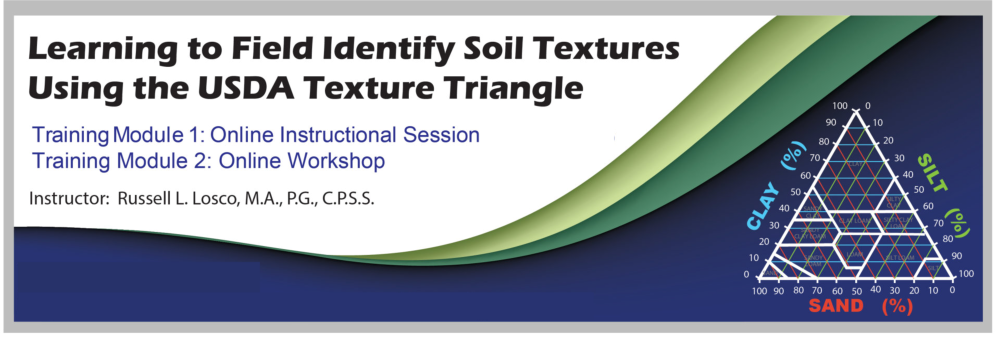
On-Demand Webinar
Learning to Field Classify Sediments using the
USDA Texture Triangle Training Module 2: Online Workshop
Designed and priced for the Individual
(at home or in the office)
The USDA textural classification was developed primarily for assessing suitability for agricultural production. Consequently, it's more concerned with the finer grained sand-silt-clay percentages. As such, its textural classes categorize recognizable differences in these grain-size components.
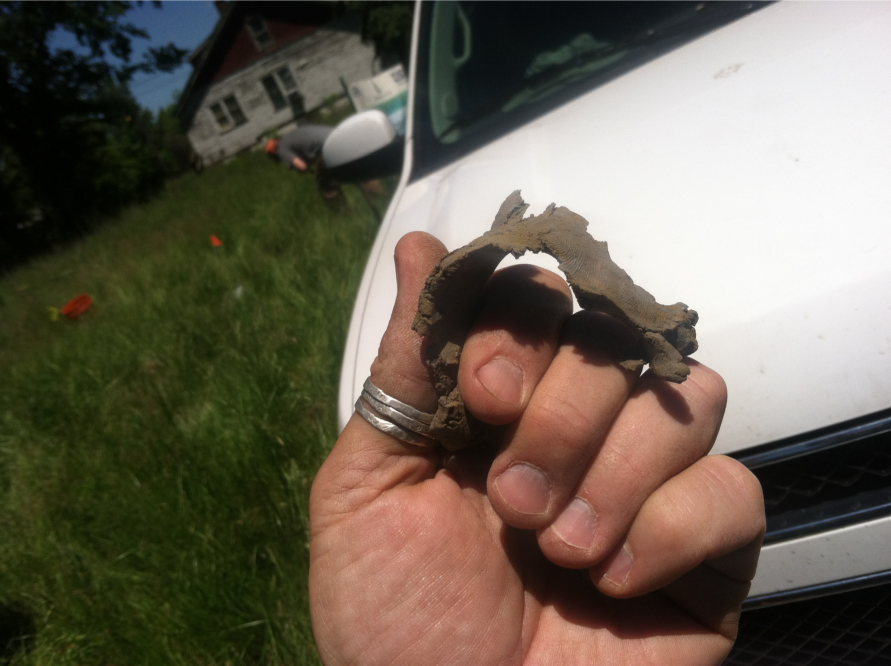
Texture class is related to weathering and parent material. Soil horizons may be differentiated based on texture of their respective parent materials. Texture class can be determined fairly well in the field by feeling the sand particles and estimating silt and clay content by flexibility and stickiness.
Although USDA soil textures are universal, sometimes it helps to be familiar with local soil composition. These are, but not limited to, the presence of carbonate minerals, clay mineralogy, and parent material. If field and laboratory determinations are inconsistent, one or more of these conditions is suspected.
Moisture content is independent of soil classifications / soil texture. It's important to learn how to optimize the soil moisture of a hand-held sample in order to produce ribboning affects and feel the plasticity of the fine-grained component. This is why we bring a spray bottle to the field with us, no matter the field classification system.
Sometimes soil conditions, components, and incorrectly executed procedures can cause inconsistencies between field texture estimates and standard laboratory data.
So, now is the time to learn the proper textural procedures and practice your skills with calibrated soil samples.
Advantages of the USDA Textural Class System are:
- It's widely used in agronomic soil science.
- The different textural classes differ noticeably from one another, so with calibration and practice, it's relatively easy to accurately distinguish these different textural classes in the field.
The limitation of the USDA Textural Class System is:
- It was not designed to have wide utility in classifying gravelly soils. Although terms for gravel-size fragments are added to the textural terms if gravel makes up over 20% of the soil mixture, using a prescribed step-wide procedure for adding those modifiers.
WHAT YOU GET
Training Module 2: Online Workshop
- Pre-Training Event Preparation Video
- Calibrated USDA Soil Samples for Workshop Exercises and Practice
- 2.0 hours of personalized instruction
- Handouts
- Post-Training Personalized Follow Up
- CEU Certificate from Midwest GeoSciences Group
ONLINE INSTRUCTIONAL MODULE: ( more info here )
Online Course Module 1 is a lecture designed to provide instructions for implementing the Burmister Soil Classification System.
ONLINE WORKSHOP MODULE: (this training module)
Online Course Module 2 is a hands-on workshop with soil samples for individuals to practice classifying sediments according to the USDA Textural Classification System. We have selected samples that span the range of grain-size and characteristics that are captured by this common classification system.
Instructors Bio
Russell L. Losco, M.A., P.G., C.P.S.S.
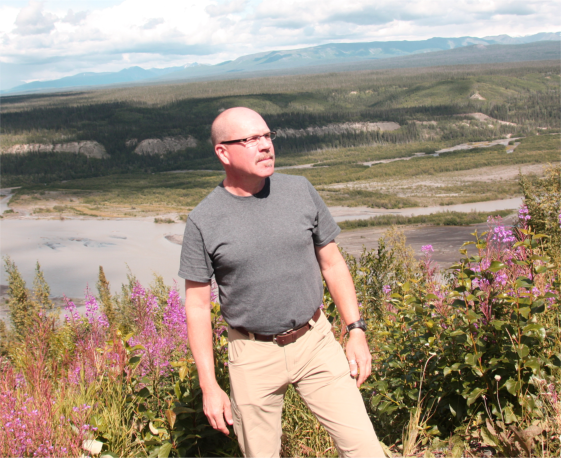 Russell Losco is a licensed Professional Geologist and a Certified Professional Soil Scientist, with over 38 years of experience in the private sector. He is the co-owner of Lanchester Soil Consultants, Inc. and an adjunct professor of Earth Science at West Chester University, where he has taught for over a decade. He holds a bachelor's degree in anthropology/archaeology and a master's degree in geosciences. His consulting work and research has stretched from Alaska to Puerto Rico, Costa Rica and Peru. He is the lead author of The Traveler's Guide to the Geology of Costa Rica, the PAPSS Manual for Soil Investigation in Pennsylvania and co-author of a chapter in the book Soils and Human Health. He is the creator and producer of the Podcast "A Poorly Sorted but Well-Rounded Series", a production of the Pennsylvania Council of Professional Geologists. His research includes soil genesis, periglacial features, serpentine-derived soil and micro-plastics in soils. Russell Losco is a licensed Professional Geologist and a Certified Professional Soil Scientist, with over 38 years of experience in the private sector. He is the co-owner of Lanchester Soil Consultants, Inc. and an adjunct professor of Earth Science at West Chester University, where he has taught for over a decade. He holds a bachelor's degree in anthropology/archaeology and a master's degree in geosciences. His consulting work and research has stretched from Alaska to Puerto Rico, Costa Rica and Peru. He is the lead author of The Traveler's Guide to the Geology of Costa Rica, the PAPSS Manual for Soil Investigation in Pennsylvania and co-author of a chapter in the book Soils and Human Health. He is the creator and producer of the Podcast "A Poorly Sorted but Well-Rounded Series", a production of the Pennsylvania Council of Professional Geologists. His research includes soil genesis, periglacial features, serpentine-derived soil and micro-plastics in soils.
| Fee: |
299.00 USD Per Webinar
|
| Materials and Downloads: |
Additional Materials- 6 Soil Samples
- QR Code USDA to TUTORIALS and ANSWERS
Record of Attendance Form (PDF)
|
Number of
Participants: |
As of June 1, 2020, online training is designed and priced for individuals working alone.
|
Continuing
Education
Certificates: |
$14.95 each. Official CEU certificates are available as an option. After successful completion of this webinar, a link will be provided to order a certificate from Northern Illinois University.
A 'Certificate of Completion' is available for the following Professionals:
AL PGs, DE PGs, IA CGWPs, IN PGs, KS PGs, LA PGs, MI PEs, MN PGs, NH PGs, NJ LSRPs, NY PE/PGs, NC PGs, PA PGs, SC PGs, SD PRSPs, TX PGs, WI PGs
|
| Access: |
On-demand, anytime 24/7. |
| Discounts: |
Buy 3 on-demand webinars, and get 3 on-demand webinars for free!
|
| Duration: |
120 minutes |
| PDH Earned: |
2.0 hours |
| |
|
| Instructor(s): |
Russell L. Losco, M.A., P.G., C.P.S.S. |
|
Become A Member
It's Free, It's Easy and as a
Member you'll enjoy...
- Exclusive Videos
- Special Pricing
- And Much More
|
|
Join
|
Learn More
|
Association of Environmental
& Engineering Geologists
|