
MODERN STATISTICS FOR GROUNDWATER COMPLIANCE AND COPING WITH DIFFICULT DATA: PART 1:
Using Confidence Intervals to Assess
Compliance and Clean-Up
 Get updated with the latest ground water statistical tools for managing confusing data, common thorny problems, and compliance challenges.
Confusion about ground water statistics is common despite clear regulatory requirements for assessing groundwater compliance. The process can be even more daunting because of statistical-decision-making demands adequate evidence of data quality, sufficient amount of data, and proper data management.
 Even when you can manage those thorny statistical problems, we are required to make defensible decisions about how the data was processed to avoid either a waste of precious resources or situations where the data are inadequate or too uncertain to allow for a clear decision.
How can modern statistical methods help you judge compliance with groundwater protection standards and determine when clean-up goals have been reached?
Discover how to recognize and cope with situations that demand special statistical treatment, especially for cases of (1) trending, (2) correlated, and/or (3) non-detect data. For example, a single exceedance is often flagged to indicated groundwater quality is out-of-compliance, when in reality such 'evidence' is wholly inadequate, leading frequently to wasted time because of wrong decisions and possibly regulatory follow-up. This webinar series provides alternative solutions that are technically defensible while maintaining adequacy of your monitoring program.
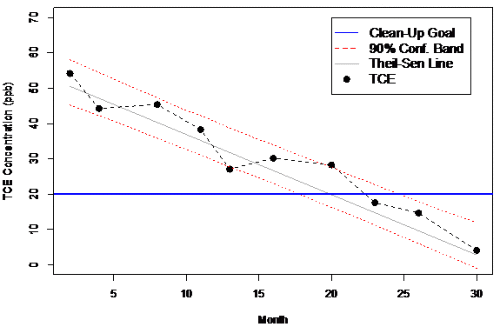
 Part 1 highlights the latest methods and strategies for identifying and delineating trends in groundwater quality measurements, and how that data can be properly utilized to test for compliance with groundwater protection standards or to evaluate the status of remedial actions.
Learn the critical regulatory difference between achieving compliance with groundwater limits and attaining clean-up standards, and how different kinds of groundwater trends can impact these decisions.
REGISTER NOW and discover how different trend patterns dictate specific statistical methods for estimating trends and building applicable confidence limits, found no where else on the web.
Webinar Highlights:
- How statistical decision making is used to assess groundwater compliance and also the status of remedial efforts
- Why different kinds of groundwater trends dictate different statistical treatments
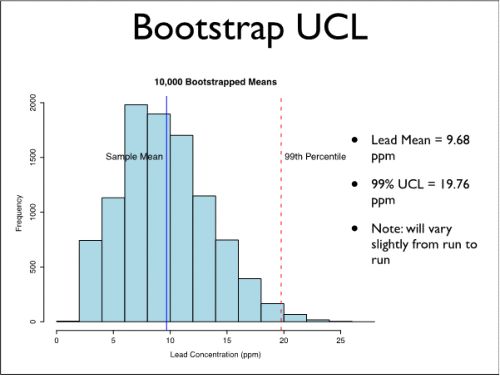
- How to use confidence limits for both stable and trending data
Technical benefits:
- Learn to distinguish types of trends and their appropriate statistical treatment
- Learn to distinguish between types of confidence limits and when to use each
- Discover examples of useful and persuasive statistical visualization of compliance results
| Fee: |
299.00 USD Per Computer Site (unlimited participants per site)
249.00 USD Per Computer Site (unlimited participants per site)
when Members also register for the following Webinar:

(discount will be applied during checkout when both are in your cart)
Pay one site registration fee and an unlimited number of participants from your organization can attend at that site.
|
| Instructor: |
Kirk Cameron, Ph.D |
| Handouts: |
Copy of Webinar Slides (pdf)
Record of Attendance Form (pdf)
|
| Duration: |
1.5 hours plus Q&A
(no restrictions on time limit for extra Q&A!)
|
Professional
Development: |
Earn 1.5 Professional Development Hours (1.5 PDH)
 |
A Record of Attendance Form is included free with each webinar for your record keeping and individual PDH verification. We ask your on-site coordinator to return the completed and signed copy of the Form to us following the webinar for (1) maintaining a separate copy as a service to attendees and (2) forwarding to NIU confirming attendance for those who order certificates.
Attendees may also order an official a Course Completion Certificate from Northern Illinois University for a small administrative fee. The Certificate is optional and may be ordered separately following the webinar to confirm your attendance and showcase the certificate on your office wall. Instructions for ordering certificates are given during the webinar.

* This webinar is eligible for the 'BUY THREE, GET THREE' discount; however the two-part webinar series discount shown above cannot be combined with it.
Attendees will be invited to actively participate during this live and interactive on-line web seminar. Discussion is planned following the webinar for those who want to continue the session. Bring your questions to the webinar and present them to the instructor and other participants for exploring the best solution.
Instructors Bio
Kirk M. Cameron, Ph.D.
Founder & President MacStat Consulting
 Kirk M. Cameron, Ph.D. is the founder and president of MacStat Consulting, Ltd. in Colorado Springs, a statistical consulting firm specializing in environmental statistical applications and problem solving. Began serving as a consultant to USEPA beginning in 1990, when he worked for Science Applications International Corporation (SAIC) in Northern Virginia. Currently consulting to EPA, DoD, DoE, the US Air Force, and private environmental and medical firms.
Education:
Ph.D. in Statistics, Stanford University, 1990
M.S. in Statistics, Stanford University, 1989
B.S. in Mathematics, University of Nebraska-Lincoln, 1984
Professional Recognitions:
- Primary author of EPA's 2009 Unified Guidance for the statistical analysis of groundwater monitoring data.
- Design and teach training courses on the statistical analysis of groundwater monitoring data, presented to regulators, consultants, and environmental professionals around the country. Filmed a commercial videotape training series on groundwater data analysis.
- Wrote a guidance document for EPA on the geostatistical analysis of soils data. Emphasized techniques for balancing sampling costs against uncertainty in geostatistical studies.
- Developed a publicly-available geostatistical and statistical-based software application (GTS) for the US Air Force to optimize sampling frequencies and locations at sites undergoing long-term ground-water monitoring (LTM).
- Provide expert review and analysis of groundwater monitoring programs at RCRA hazardous waste sites across the country.


