BORING LOG BASICS: PART 2:
Benefits of Fundamental Field Analysis
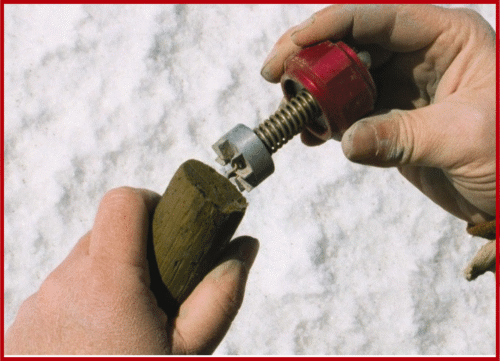 Competitive bidding has forced environmental project managers to more closely examine the process at which we approach subsurface investigations. Many problems may be avoided when field staff are capable of thinking on their feet and understand the context for their work. This webinar provides a meaningful process and some ways to help staff to confidently take the mystery out of the subsurface - which is the job we are hired to do as professionals
TAKING THE MYSTERY OUT OF THE SUBSUFACE ®
This 60-minute webinar shows the benefits of thinking on our feet and addresses the common field problems that plague our industry. Attendees will benefit from this webinar by learning how adjusting field perspectives and procedures can improve meeting project objectives and control project costs by:
- Identifying and managing unexpected subsurface conditions
- Cope with changes in the field and presenting change orders
- Minimizing wasted field efforts
- Creating a process that allows real-time QA/QC for subsurface characterization and mapping
Hydrogeologic field analysis is a project management style that supports making field decisions during field activities, making sense of subsurface samples from boring-to-boring, targeting meaningful monitoring well placements, and selecting geotechnical samples that are rational and diagnostic of actual site-specific conditions.
BENEFITS OF FIELD ANALYSIS
One of the first steps in a fundamentally sound subsurface investigations is BORING LOGS that are complete and accurate. Most boring logs can be improved with a few simple changes. A change in perspective about how we see the sedimentary sequence can often simplify the process while helping prepare more reliable boring logs.
Describing every detail of every sample is not the answer. When the field professional understands (1) geologic context and (2) scale of deposition, and (3) affects of secondary weathering, it is the first step in Taking the Mystery Out of the Subsurface.
Let's face it, we all have preferences, styles and habits when preparing boring logs. Most of our habits are sufficient, but most professionals realize that education, training and practice help the ability of staff to think on their feet while yielding boring logs that are accurate and complete...and credible.
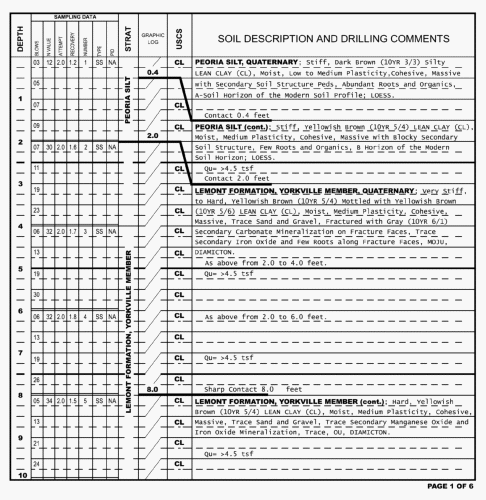
Benefits of Good Boring Logs
- Achieves the primary objective of taking the mystery out of the subsurface.
- It's money wisely spent.
- Enables others to reliably understand the subsurface.
- Create efficiencies and allows for certainty in other project tasks.
- Provides value beyond the immediate project.
- Showcases work for business development purposes.
- Allows personal pride and achievement.
Plus, this unique online experience invites site coordinators to share their own experiences in order to help all of us think better on our feet in the field.
PARTICIPANTS WILL BENEFIT BY:
- Gaining fundamental insights about field analysis
- Defining subsurface units
- Correlating borings in the field
- Basic field analysis to reduce subsurface uncertainty
- The use and misuse of high resolution sampling technologies
- Mapping the distribution of hydraulic conductivity
- Discovering tips and tricks from other webinar participants about logging techniques.
"Midwest GeoSciences Group - Boring Logs On-Demand Webinar was a great re-fresher course. (It ) reminded me how important accurate soil logging is always the framework for future decisions of great consequence. Also that old geologists can get set in their ways and need a re-fresher course now and then to keep them in line." - Steve Kobberdahl...25 yrs. logging glacial soils in Iowa and Midwest
Instructors Bio
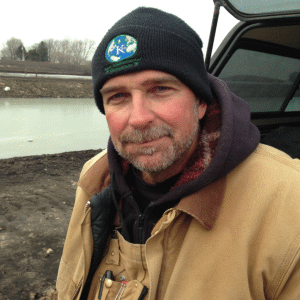 Dan Korth, PG, is Vice-President and Project Manager at Korth Environmental GeoSciences, Inc. Dan Korth is recognized for both the quality of his boring logs and his field analysis strategies of sedimentary sequences.
After earning his Geology B.Sc. at Illinois State University, Dan worked for Chevron, Inc. as a Geologist and Geophysical Analyst. He was later recruited by Waste Management, Inc for his keen ability to assess subsurface conditions in the field and became a technical group leader in a consulting role.
Today, Dan is recognized for his expertise in creating original and site-specific field analysis strategies. Dan teaches staff about the key observations of sedimentary successions and how to unravel their complexity through field analysis and meaningful boring logs.
 Dan Kelleher is a hydrogeologist and project manager who strives for excellence in subsurface characterization. His technical expertise is quantitative hydrogeology (in porous and fractured media), geotechnical analysis of sedimentary sequences, aquifer testing and predictive ground water modeling.
He promotes field analysis during stratigraphic characterization from boring to boring in order to utilize QA/QC processes fully throughout a project and help identify unexpected conditions as soon as they arise.
Dan is a registered Professional Geologist (PG) and Certified International Project Manager (CIPM). He earned his undergraduate degree in Geology from Monmouth College and his Master's in Hydrogeology from Northern Illinois University. Besides contributing to several other organizations, Dan is the Solid and Hazardous Waste Subcommittee Chair for the Association of Engineering Geologists.


